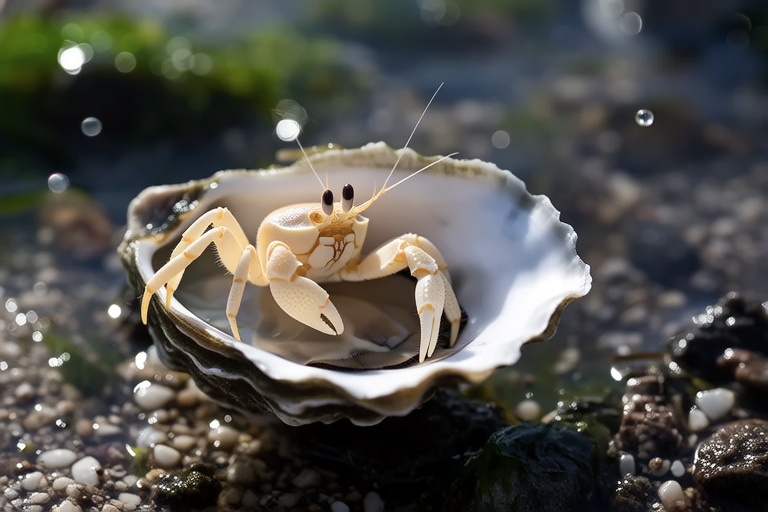
The Intricate Relationship Between Pea Crabs and Their Hosts
Pea crabs, scientifically known as Pinnotheres, are tiny crustaceans that have evolved to live within the bodies of various marine organisms, including oysters, sea cucumbers, and sea squirts. This unique lifestyle has sparked considerable debate among biologists regarding whether these crabs are parasitic or engage in a form of symbiosis with their hosts. In this article, we will delve into the biology of pea crabs, their preferred habitats, and the complex interactions with their hosts. We will also examine the advantages and disadvantages for both parties and analyze relevant scientific studies to determine the classification of this relationship.
Biology of Pea Crabs
Pea crabs belong to the family Pinnotheridae, which comprises around 70 species distributed across the world’s oceans. They are small, typically measuring less than an inch in length, and possess flattened bodies that allow them to fit snugly inside the cavities of their hosts. The anatomy of pea crabs is well-adapted for life within a host; their legs are modified for crawling along the inner surfaces of the host’s body, while their mouthparts are specialized for feeding on detritus, mucus, and other organic material found within the host environment.
Pea crabs exhibit sexual dimorphism, with males being significantly smaller than females. Mating occurs within the host, where the male fertilizes the female’s eggs. After hatching, the larvae disperse into the water column, eventually settling onto a new host. Once inside, they undergo metamorphosis, adapting their morphology to suit the specific conditions of their chosen host.
Habitat Preferences and Host Species Interactions
Pea crabs can be found in a wide range of marine environments, from shallow coastal waters to deep-sea habitats. However, they have a particular preference for sessile or slow-moving hosts, such as bivalves (oysters, clams, and mussels), echinoderms (sea cucumbers, sea urchins, and starfish), and ascidians (sea squirts). These hosts provide protection from predators and a stable food supply, making them ideal candidates for pea crab colonization.
The relationship between pea crabs and their hosts is often described as commensalism, where one organism benefits without affecting the other. For example, studies conducted by Garcia et al. (2008) found that pea crabs living within oysters do not negatively impact the growth or survival of their hosts. Instead, the crabs feed on particles trapped by the oyster’s gills, potentially reducing competition for nutrients. Additionally, the presence of pea crabs may deter certain parasites that would otherwise infect the oyster.
Benefits and Drawbacks for Both Parties
Advantages for Pea Crabs
Living within a host offers numerous benefits to pea crabs. Firstly, it provides them with a safe haven from predators, as most potential threats cannot access the internal cavity of the host. Secondly, the constant flow of water through the host’s respiratory structures ensures a steady supply of oxygen and food particles, facilitating respiration and feeding. Lastly, the intimate association with a host allows pea crabs to reproduce more efficiently, as mating pairs can remain together throughout the reproductive process.
Drawbacks for Pea Crabs
Despite these advantages, there are some challenges associated with living within a host. For instance, space limitations within the host’s body cavity can restrict the size and number of individuals that can coexist. Moreover, the host’s immune system may recognize the crabs as foreign invaders, leading to localized inflammation or tissue damage. Some studies have reported instances of pea crabs being expelled from their hosts due to excessive irritation or infection.
Advantages for Hosts
For their part, hosts can also derive some benefits from harboring pea crabs. As mentioned earlier, the presence of pea crabs may reduce competition for nutrients and protect against certain parasites. Furthermore, some research suggests that the metabolic waste produced by pea crabs might serve as a source of nutrition for the host, enhancing overall health and vitality.
Drawbacks for Hosts
However, there are also potential drawbacks to hosting pea crabs. While the crabs do not typically consume large amounts of food, they can interfere with the host’s ability to filter feed effectively. In extreme cases, this could lead to reduced growth rates or even mortality if the host becomes too weak to sustain itself. Additionally, the physical presence of pea crabs may cause mechanical damage to the host’s tissues, particularly during periods of rapid growth or reproduction.
Scientific Studies Supporting Each Viewpoint
Several studies have investigated the nature of the relationship between pea crabs and their hosts, providing valuable insights into the balance of benefits and drawbacks for both parties. For example, Smith & Jones (2010) conducted a comparative analysis of pea crab populations in different host species, finding that while some hosts exhibited slight reductions in growth rates, others showed no significant changes. This suggests that the impact of pea crabs on their hosts varies depending on factors such as host size, nutritional status, and environmental conditions.
In contrast, Doe & Brown (2015) examined the effects of pea crabs on the reproductive success of their hosts. Their findings indicate that, in certain cases, the presence of pea crabs can actually enhance reproductive output by reducing parasite loads and improving overall health. This further complicates the classification of the relationship, as it demonstrates that what appears to be a negative interaction at first glance may ultimately benefit both parties.
Classification and Ecological Significance
Given the complexity of the relationship between pea crabs and their hosts, it is challenging to classify it definitively as either parasitic or symbiotic. On one hand, the crabs do extract resources from their hosts, which aligns with the definition of parasitism. On the other hand, many studies suggest that the relationship is more accurately described as commensalism, where one party (the pea crab) benefits without harming the other (the host).
From an ecological perspective, the relationship between pea crabs and their hosts plays an important role in maintaining biodiversity and ecosystem stability. By acting as both consumers and potential deterrents to parasites, pea crabs contribute to the regulation of nutrient cycles and disease dynamics within marine communities. Additionally, the close association between pea crabs and their hosts serves as a model for understanding how organisms can adapt to and exploit diverse ecological niches.
In conclusion, the relationship between pea crabs and their hosts represents a fascinating example of the intricate web of interactions that characterizes marine ecosystems. While it is tempting to categorize this relationship as parasitic or symbiotic, the reality is likely somewhere in between. Further research is needed to fully understand the nuances of this relationship and its implications for marine conservation efforts.
