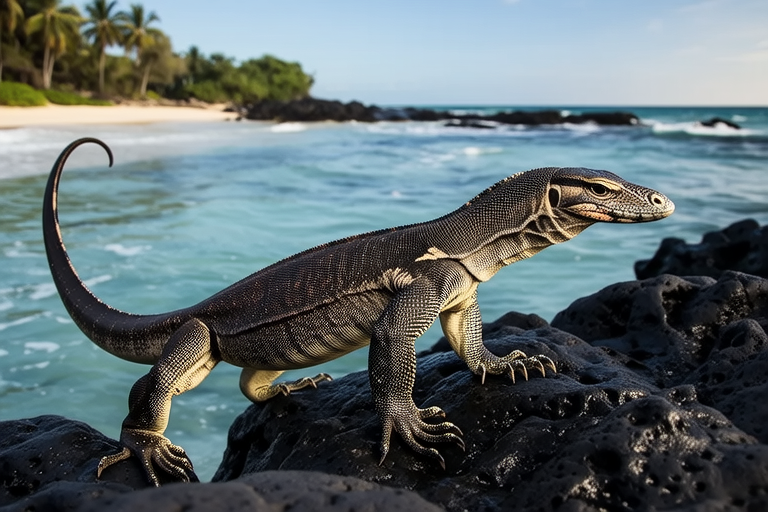
Aquatic Adventures: How Water Monitors Thrive Between Land and Sea
In the vast tapestry of Earth’s ecosystems, few creatures embody the spirit of adaptability as vividly as the water monitor (Varanus salvator). These remarkable reptiles are masters of both land and sea, thriving in environments where many species struggle to survive. This article delves into the fascinating world of water monitors, exploring their unique adaptations, behaviors, and the challenges they face in their dual habitats.
Physical Attributes and Adaptations
The water monitor boasts a sleek, elongated body, typically measuring between 1.2 and 2 meters in length, with some individuals reaching up to 3 meters. Their muscular tails, which can be as long as their bodies, serve multiple purposes, from swimming propulsion to balance and defense. The tail is also equipped with a powerful musculature, allowing the monitor to swim with great agility and speed.
Water monitors have flattened snouts and nostrils located at the tip of their snouts, enabling them to breathe while partially submerged. Their eyes are positioned high on their heads, providing excellent vision above and below the waterline. Their tongues are long and forked, enhancing their ability to detect chemical signals in the air and water, which aids in locating prey and navigating their environment.
One of the most notable adaptations of water monitors is their skin, which is covered in small, overlapping scales. These scales provide protection against abrasions and predators, while also allowing for efficient thermoregulation. The coloration of water monitors ranges from olive green to brown, often with yellowish spots or stripes, offering camouflage in their diverse habitats.
Diet and Feeding Habits
Water monitors are opportunistic feeders with a diet that includes a wide variety of prey. They are carnivorous, consuming fish, frogs, birds, eggs, insects, and even small mammals. Their sharp teeth and powerful jaws enable them to seize and crush prey effectively. In aquatic environments, they are skilled hunters, ambushing fish and amphibians with lightning-fast strikes.
These reptiles have an impressive hunting technique known as ‘sit-and-wait,’ where they remain motionless for extended periods, waiting for unsuspecting prey to come within striking distance. Once a target is identified, they strike with incredible speed and accuracy, often submerging to catch fish or other aquatic animals.
Water monitors play a crucial role in maintaining ecological balance by controlling populations of certain species. Their presence helps prevent overpopulation of prey animals, contributing to the health and stability of their ecosystems.
Habitat Preferences and Behaviors
Water monitors are highly adaptable and can be found in a wide range of habitats, including mangrove swamps, rivers, lakes, and coastal areas. They prefer areas with dense vegetation, which provides cover and hiding spots. These reptiles are equally at home on land and in water, moving freely between the two environments in search of food and shelter.
On land, water monitors are active during the day, basking in the sun to regulate their body temperature. They are excellent climbers, using their strong limbs and prehensile tails to scale trees and rocks. In the water, they are graceful swimmers, propelling themselves through the currents with ease. They can hold their breath for up to 30 minutes, allowing them to explore deeper waters in search of food.
During the breeding season, males engage in ritualized combat, using their tails and jaws to assert dominance over rivals. After mating, females lay clutches of 10 to 50 eggs, usually in termite mounds or underground burrows. The eggs incubate for several months before hatching, producing miniature versions of their parents.
Challenges and Survival Strategies
Despite their adaptability, water monitors face numerous challenges in their dual environments. One of the primary threats they encounter is predation. Larger predators such as crocodiles, snakes, and birds of prey pose a significant risk, especially to juveniles. To avoid becoming prey, water monitors rely on their agility, speed, and ability to quickly retreat to the safety of water or dense vegetation.
Human activities, including deforestation, pollution, and habitat destruction, also impact water monitors. As wetlands and forests are cleared for agriculture and urban development, the availability of suitable habitats decreases, forcing these reptiles to compete for limited resources. Conservation efforts aimed at protecting these ecosystems are essential for ensuring the survival of water monitors.
Climate change poses another challenge, altering weather patterns and water levels. Rising temperatures and changing rainfall patterns can affect the availability of prey and suitable nesting sites. However, water monitors have demonstrated resilience in the face of environmental changes, adapting their behavior and habitat use to cope with shifting conditions.
Recent Studies and Conservation Efforts
Recent studies have shed light on the complex social structures and communication methods of water monitors. Researchers have observed that these reptiles use a combination of visual, auditory, and chemical cues to interact with one another. Understanding these communication methods can provide valuable insights into their behavior and help inform conservation strategies.
Conservation initiatives focused on water monitors include habitat restoration projects, anti-poaching measures, and public awareness campaigns. These efforts aim to protect existing populations and promote the recovery of threatened species. Collaboration between scientists, local communities, and government agencies is crucial for the success of these initiatives.
One notable project involves the establishment of protected areas where water monitors can thrive without the threat of human interference. These areas provide safe havens for the reptiles, allowing them to reproduce and expand their populations. Additionally, captive breeding programs have been established to bolster wild populations and reintroduce individuals into their natural habitats.
Conclusion
The water monitor is a testament to the incredible diversity and adaptability of life on Earth. Their unique physical attributes, behaviors, and diet enable them to excel in both aquatic and terrestrial environments, making them formidable survivors in a rapidly changing world. By understanding and protecting these remarkable reptiles, we can ensure their continued existence and contribute to the health and balance of our planet’s ecosystems.
