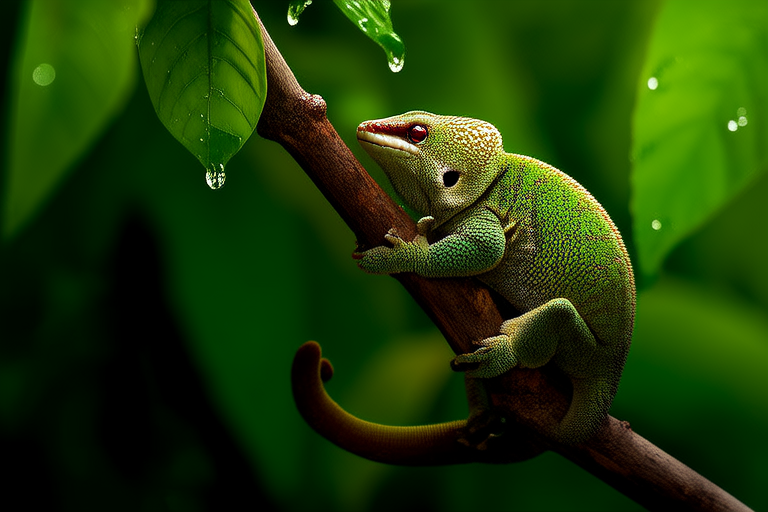
The Secret Life of Chameleons: Unveiling Their Mysterious World
Chameleons have long captivated the imagination with their unique ability to change colors. These fascinating creatures are more than just masters of disguise; they are highly specialized animals with intriguing behaviors and adaptations. From their distinctive anatomy to their social interactions, chameleons offer a window into a mysterious world that is both captivating and scientifically significant.
Anatomy of a Chameleon
Chameleons possess a range of anatomical features that set them apart from other reptiles. One of the most notable is their long, sticky tongue, which can extend up to twice the length of their body. This adaptation allows them to catch insects with remarkable precision. Their eyes, too, are uniquely adapted for their lifestyle. Each eye can move independently, giving them nearly 360-degree vision and the ability to focus on two different objects simultaneously.
Another distinguishing feature is their feet, which are designed for gripping branches and climbing. They have zygodactyl feet, meaning that the toes are grouped in clusters, allowing them to grasp surfaces securely. Their tails are prehensile, meaning they can wrap around branches for support, much like a monkey’s tail.
The Color-Changing Ability
Perhaps the most famous characteristic of chameleons is their ability to change color. Contrary to popular belief, chameleons don’t change color to blend into their surroundings as a form of camouflage. Instead, they use this ability primarily for communication and temperature regulation. The color changes are the result of specialized cells called chromatophores, which contain pigments that reflect or absorb different wavelengths of light.
When a chameleon feels threatened, it may darken its skin to appear larger and more intimidating. Conversely, when it is relaxed or comfortable, it might display brighter colors to attract mates or establish dominance within its social group. Recent studies have also shown that chameleons can change color faster than previously thought, indicating a sophisticated neural control system governing these changes.
Dietary Habits
Chameleons are insectivores, feeding mainly on insects such as crickets, grasshoppers, and locusts. Their diet is rich in protein, which supports their rapid growth and high metabolic rate. In captivity, chameleons are often fed commercially available insects, but it’s important to ensure a varied diet to meet all nutritional needs.
While their primary food source is insects, some species have been observed eating small vertebrates or even plant matter in times of scarcity. However, this is not typical behavior, and their digestive systems are primarily adapted for processing animal-based diets.
Habitat Preferences
Chameleons are found in a wide range of habitats across Africa, Madagascar, southern Europe, and parts of Asia. They thrive in environments that provide plenty of vertical space, such as trees and bushes, where they can hunt and hide effectively. Their preferred habitats include rainforests, savannas, and rocky outcrops, depending on the species.
Many chameleon species are arboreal, spending most of their lives in trees. Others are ground-dwelling, preferring open spaces with low vegetation. Despite their adaptability, many chameleon species face threats due to habitat loss and fragmentation. Conservation efforts are crucial to protect these delicate ecosystems and the chameleons that depend on them.
Social Behaviors
Contrary to popular belief, chameleons are generally solitary animals. They prefer to live alone and will actively defend their territory against intruders. During mating season, however, males may engage in elaborate displays to attract females. These displays often involve vibrant color changes and physical posturing.
Female chameleons are known to be selective in choosing mates, often rejecting males who do not meet their criteria. After mating, the female may lay eggs, which she buries in the soil. Depending on the species, she may lay anywhere from 10 to 60 eggs at a time. The eggs incubate underground until they hatch, typically after several months.
Common Misconceptions
One of the most common misconceptions about chameleons is that they change color to blend into their surroundings. While this idea makes for an interesting story, it’s not entirely accurate. As mentioned earlier, chameleons use color changes primarily for communication and thermoregulation.
Another misconception is that chameleons can only eat insects. While insects make up the bulk of their diet, some species have been observed consuming small vertebrates or plant matter when necessary. Additionally, there is a myth that chameleons can sleep with their eyes open, but this is not true. Like most reptiles, chameleons close their eyes during sleep.
Recent Scientific Discoveries
In recent years, scientists have made significant strides in understanding the complex world of chameleons. For example, researchers have discovered that the color-changing mechanism in chameleons is far more intricate than previously thought. The process involves not just the movement of pigment-containing cells but also the arrangement of nanocrystals beneath the skin.
Another exciting discovery is the role of chameleons in pollination. Some species have been observed visiting flowers and inadvertently transferring pollen from one flower to another. This finding suggests that chameleons may play a more significant ecological role than previously recognized.
Furthermore, advancements in genetic research have helped clarify the evolutionary relationships between different chameleon species. By analyzing DNA sequences, scientists have been able to reconstruct the family tree of chameleons, providing valuable insights into their evolutionary history and diversification.
Conservation Efforts
Despite their popularity as pets and their critical role in ecosystems, many chameleon species are facing severe threats. Habitat destruction, climate change, and illegal pet trade are among the major challenges. Conservation organizations and researchers are working together to protect chameleons and their habitats.
Efforts include establishing protected areas, promoting sustainable practices, and raising public awareness about the importance of preserving biodiversity. Captive breeding programs are also underway to help maintain healthy populations of endangered species. These initiatives aim to ensure that future generations can continue to marvel at the secret life of chameleons.
Conclusion
The secret life of chameleons is a testament to nature’s ingenuity and complexity. From their remarkable anatomy to their unique social behaviors, chameleons offer a wealth of fascinating insights into the natural world. By understanding and appreciating these creatures, we can better protect them and the ecosystems they inhabit.
As research continues to uncover new aspects of chameleon biology, we gain a deeper appreciation for the intricate web of life that connects us all. Let us continue to explore and celebrate the mysteries of the natural world, including the secret life of chameleons.
